
Optical Transceiver Market Surges Toward USD 41.89 Billion by 2035 at 12.65% CAGR
Optical Transceiver Market Size, Share and Research Report By Technology (Single-Mode Fiber, Multi-Mode Fiber, Active
Press Release Disclaimer: This is a press release distributed through the XPR Media network. It has not been independently verified by our newsroom.

Optical Transceiver Market Size, Share and Research Report By Technology (Single-Mode Fiber, Multi-Mode Fiber, Active Optical Cable, Passive Optical Cable)
NEW YORK,, NY, UNITED STATES, September 21, 2026 /EINPresswire.com/ — The Optical Transceiver Market is expanding rapidly as cloud computing, artificial intelligence, data centers, and high-speed communications increase demand for reliable optical networking. The Optical Transceiver Market is becoming essential for moving large volumes of digital information across data center, telecom, enterprise, and broadband networks with higher speed and efficiency.
➤ Market Overview:
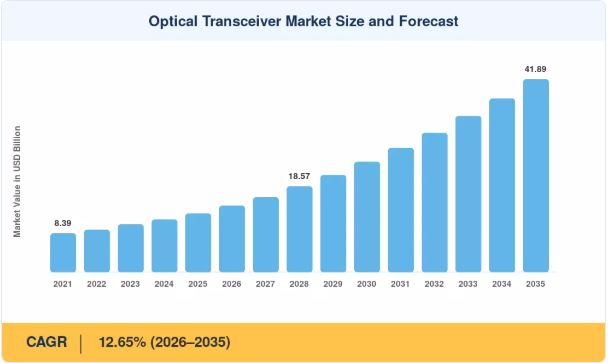
The Optical Transceiver Market closed 2025 at approximately USD 12.73 billion and is projected to reach USD 14.34 billion in 2026. The market is expected to expand to nearly USD 41.89 billion by 2035, representing a strong 12.65% CAGR during 2026–2035 as optical connectivity requirements continue to rise.
North America accounts for about 31.5% of 2025 revenue, supported by hyperscale campus construction across major technology hubs. Asia-Pacific is expected to grow fastest at approximately 13.6% through 2035, while Europe holds around 25.4% share, supported by digital connectivity initiatives and network modernization.
The rapid growth of digital services is increasing the amount of data transferred through communication networks. Enterprises, cloud platforms, content providers, and telecommunications operators require faster and more reliable connections to support expanding traffic volumes. Optical transceivers convert electrical signals into optical signals and back again, enabling efficient communication across fiber-optic networks. Their ability to support high bandwidth over long distances makes them fundamental to modern data center and telecommunications infrastructure.
Get Full PDF Sample Copy of Report: (Including Full TOC, List of Tables & Figures, Chart) @
https://www.marketresearchfuture.com/sample_request/6066
➤ How Significant Is the Optical Transceiver Market’s Growth?
The optical transceiver market’s trajectory from USD 12.73 billion in 2025 to a projected USD 41.89 billion by 2035 represents more than a three-fold expansion over the forecast decade, reflecting the structural shift from grey 10G and 40G client optics toward 400G and 800G modules purpose-built for AI collective-communication traffic, and from standalone transponder shelves toward coherent pluggables that drop straight into router faceplates. The market’s 12.65% CAGR is anchored in a bandwidth-and-standardisation supercycle where AI cluster fabrics, ratified 800G/1.6T Ethernet signalling, and public broadband subsidy programmes are all converging to compress module replacement cycles across cloud, carrier, and enterprise buyers.
Ethernet protocol modules held 42.6% of market revenue in 2025, reflecting entrenched switch-port attach rates across cloud and enterprise, while coherent DWDM modules are forecast to compound at 13.8% through 2035 as ZR/ZR+ pluggables displace transponder chassis, transferring revenue from systems vendors to module vendors. Modules rated above 400 Gbps generated an estimated USD 2.71 billion in 2025 and are forecast to expand at a 13.7% CAGR as AI cluster fabrics and 800G switching scale.
By fiber type, single-mode holds 58.0% share as campuses grow physically larger, exceeding practical multi-mode reach at high data rates, while multi-mode still grows respectably at a 13.3% CAGR because AI rack-scale topologies generate enormous volumes of very short links where VCSEL-based optics remain cheapest. By application, data centers captured 51.9% of 2025 revenue across the market, while telecommunications deployments are projected to grow at an 11.9% CAGR over the forecast window, propelled by 5G transport and metro coherent upgrades.
➤ What Does the Future Hold for the Optical Transceiver Market?
AI/ML cluster fabric buildout contributes approximately 3.4 percentage points to the optical transceiver market’s CAGR the single highest driver impact. Accelerator fabrics have reset volume assumptions across the market. A rail-optimized AI scale-out fabric can attach eight or more optics per accelerator, with a second tier of optics between leaf and spine, whereas a traditional cloud rack attaches two to four optics per server. NVIDIA’s Quantum-X800 InfiniBand platform, which debuted in March 2024, was specifically designed with 800G links in mind, and AI-specific capacity now determines the marginal build choice for the majority of the more than 1,100 active hyperscale facilities worldwide.
800G/1.6T Ethernet standardisation contributes approximately 2.6 percentage points of driver impact, establishing ratified signalling as a primary structural driver. Buyers do not commit to multi-year volumes without a ratified standard behind them, and the IEEE 802.3dj task force, chartered to define 200 Gb/s per-lane electrical and optical interfaces supporting 800 Gb/s and 1.6 Tb/s aggregate rates, gives operators confidence that second-source supply will exist.
Coherent pluggable displacement of transponders adds a further 2.1% as the OIF 400ZR Implementation Agreement makes it feasible to end a DWDM wavelength directly in a router faceplate instead of a dedicated transponder shelf, with carriers reporting significant power and rack space reductions per 400G wavelength on metro-regional spans, a shift that anchored Nokia’s acquisition of Infinera, agreed in June 2024 at roughly USD 2.3 billion and closed in February 2025. Public broadband subsidy disbursement contributes a further 1.8% as NTIA’s BEAD program commits USD 42.45 billion to broadband deployment and India’s BharatNet expansion continues to extend backhaul into gram panchayats, with every route requiring access and aggregation optics typically specified at 10G and 25G, sustaining demand for mature form factors well past their expected decline.
The next phase of the market’s evolution centers on automated optical layer operations, as network operators push telemetry-driven automation into the optical layer, using per-module diagnostic streams to predict degradation and pre-provision spares, a capability expected to shift from differentiator to table stakes by 2030. Power per bit will overtake dollars per gigabit as the primary selection criterion, with the IEA’s analysis of data centre electricity demand having made energy intensity a board-level topic, and modules delivering a 20% power advantage able to command price premiums that would have been unthinkable in 2020.
The industry is also forking architecturally between front-panel pluggables, which retain the serviceability and multi-vendor sourcing operations teams demand, and co-packaged optics, which offer power savings that become unavoidable past 100 Tb/s switch capacity, with Open Compute Project working groups effectively arbitrating this fork through the early 2030s. Supply chain regionalisation is redrawing the map as the CHIPS and Science Act and the EU Chips Act both fund photonic and advanced packaging capacity outside Asia, and export control regimes push buyers toward geographically diversified qualification lists, raising unit costs in the near term but reducing single-point-of-failure risk.
Get access to the full description of the report @
https://www.marketresearchfuture.com/reports/optical-transceiver-market-6066
➤ Who Are the Key Players in the Optical Transceiver Market?
Concentration in the optical transceiver market is moderate. The estimated Herfindahl-Hirschman Index falls in the 900-1,100 range, with the top five suppliers holding roughly 45-52% of revenue. That structure reflects genuine fragmentation at the low end, where dozens of qualified suppliers compete for 10G and 25G access optics, alongside meaningful concentration in coherent and 800G products, where DSP and laser capability create real barriers. MRFR identifies the following key participants:
• Coherent Corp
• Broadcom Inc
• Lumentum Holdings
• Marvell Technology
• Innolight Technology
• Cisco Systems
• Nokia, incl. Infinera
• Accelink Technologies
• Fujitsu Optical Components
• Source Photonics
Strategic competition in the optical transceiver market is increasingly defined by laser and DSP vertical integration and power-per-bit efficiency rather than raw port count, with ASP erosion from vertically integrated suppliers cited as a top structural headwind, contributing an estimated -2.2% drag on CAGR as vertically integrated Chinese suppliers that fabricate lasers, modulators, and detectors in-house have compressed bill-of-materials costs to a level that forces incumbents to defend share on price, alongside power and thermal ceilings at high data rates, export controls and component sourcing risk concentrated in Asia-Pacific, laser and DSP capacity constraints among a few eligible providers, and carrier capex discipline and inventory cycles.
➤ What Are the Emerging Trends in the Optical Transceiver Market?
Several transformational trends are redefining the optical transceiver market’s evolution through 2035:
Coherent Optics Moving Into the Metro Edge: The technology curve that started with 400ZR is progressing toward 800G line rates, and OIF work in this direction opens metro and regional spans that previously could not justify coherent economics, with vendors able to hold power under the OSFP thermal envelope capturing a disproportionate share in carrier accounts.
Emerging-Market Backhaul as Untapped Volume: India, ASEAN, Brazil and the Gulf states are building metro fiber at a pace that outstrips their current optics attach rate, with China’s MIIT Double Gigabit action plan setting explicit gigabit coverage targets replicated across Southeast Asia, favouring vendors with cost structures built for scale rather than leading-edge performance.
Telemetry and Lifecycle Services as Recurring Revenue: Modules now expose rich diagnostic telemetry, and operators want fleet-level analytics that predict failure before a link drops, with selling that analytic layer as a subscription alongside hardware converting a transactional relationship into a recurring one.
Co-Packaged Architectures Reshaping the Supplier Set: These designs are now coordinated through the Open Compute Project, and design-win eligibility is determined by early engagement three product generations out, with vendors left out of that discussion running the risk of losing access to the most valuable sockets.
Second-Sourcing Mandates Favouring Credible Challengers: Hyperscale buyers now formalise dual-sourcing as procurement policy, deliberately preserving a second qualified supplier at every data rate, creating a durable share floor for challengers who can pass qualification, even without price leadership.
Buy Full Research Report:
https://www.marketresearchfuture.com/checkout?currency=one_user-USD&report_id=6066
➤ How Is the Optical Transceiver Market Segmented?
The optical transceiver market report provides a comprehensive segmentation framework:
By Protocol: Ethernet (42.6% share, 2025), Coherent DWDM (13.8% CAGR), InfiniBand (USD 1.88 billion, 2025), Fibre Channel (11.5% share, 2025), Other Protocols (8.7% share, 2025)
By Data Rate: 100–400 Gbps (36.4% share, 2025), Above 400 Gbps (13.7% CAGR), 40–100 Gbps (USD 2.41 billion, 2025), 10–40 Gbps (15.2% share, 2025), Below 10 Gbps (8.2% share, 2025)
By Form Factor: QSFP28 / QSFP-DD (36.0% share, 2025), SFP / SFP+ (24.5% share, 2025), OSFP (13.8% CAGR), CFP / CFP2 / CFP4 (USD 1.68 billion, 2025), Other Form Factors (9.5% share, 2025)
By Fiber Type and Reach: Single-Mode (58.0% share, 2025), Multi-Mode (13.3% CAGR), Short-Reach (42.4% share, 2025), Medium-Reach (13.2% CAGR), Long-Reach (USD 3.35 billion, 2025)
By Application: Data Centers (51.9% share, 2025), Telecommunications (11.9% CAGR), Enterprise / Campus (USD 1.72 billion, 2025), Other Applications (6.2% share, 2025)
By Region: North America (31.5% share, 2025), Asia-Pacific (30.8% share, 2025), Europe (25.4% share, 2025), South America (5.6% share, 2025), Middle East & Africa (USD 0.86 billion, 2025)
➤ Competitive Landscape:
Competition in the optical transceiver industry is focused on transmission speed, energy efficiency, reliability, interoperability, module density, and cost. Manufacturers are rapidly developing solutions designed for newer Ethernet generations and increasingly demanding telecom applications.
Innovation is also occurring in optical integration, packaging, signal processing, and manufacturing efficiency. Strategic relationships with cloud providers, telecommunications companies, and networking-equipment manufacturers can provide vendors with access to high-growth application segments.
➤ Key Market Challenges:
The industry faces challenges such as component costs, thermal management, manufacturing complexity, interoperability, and rapidly changing technology standards. High-performance transceivers require sophisticated optical and electronic components, which can increase development and production costs.
The fast pace of network evolution also places pressure on manufacturers to continuously introduce new products. Companies must maintain performance advantages while ensuring compatibility with existing networking ecosystems and controlling energy consumption.
➤ Future Outlook:
The future of the optical transceiver industry will be shaped by artificial intelligence, hyperscale data centers, advanced Ethernet, 5G, fiber expansion, and distributed computing. Increasing network traffic will continue to push operators toward higher-capacity optical solutions.
Next-generation modules are expected to provide faster transmission, lower power consumption, smaller footprints, and greater intelligence. As data center and telecommunications architectures evolve, optical transceivers will remain a critical foundation for scalable digital connectivity.
➤ Frequently Asked Questions:
What is the Optical Transceiver Market?
It covers optical modules that convert electrical signals to optical signals and back for data transmission across fiber-optic networks.
What was the market size in 2025?
The market was valued at approximately USD 12.73 billion in 2025.
What will the market reach by 2035?
The market is projected to reach approximately USD 41.89 billion by 2035.
What is the expected CAGR?
The market is forecast to grow at a 12.65% CAGR from 2026 to 2035.
Which region holds the largest share?
North America holds approximately 31.5% of 2025 revenue.
➤➤➤ Regional & Country-Level Reports by Market Research Future:
US Optical Transceiver Market –
https://www.marketresearchfuture.com/reports/us-optical-transceiver-market-14156
➤➤➤ Industry Analysis Reports by Market Research Future:
Rf Transceiver Market
https://www.marketresearchfuture.com/reports/rf-transceiver-market-5760
Industrial Transceiver Market
https://www.marketresearchfuture.com/reports/industrial-transceiver-market-33964
Us Rf Transceiver Market
https://www.marketresearchfuture.com/reports/us-rf-transceiver-market-16807
Gaming Hardware Market
https://www.marketresearchfuture.com/reports/gaming-hardware-market-11513
Industrial Mainboards Market
https://www.marketresearchfuture.com/reports/industrial-mainboards-market-11893
Iot Communication Technologies Market
https://www.marketresearchfuture.com/reports/iot-communication-technologies-market-11898
Fiber Management Systems Market
https://www.marketresearchfuture.com/reports/fiber-management-systems-market-11929
Data Center Switch Market
https://www.marketresearchfuture.com/reports/data-center-switch-market-11964
Retail Point Of Sale Terminals Market
https://www.marketresearchfuture.com/reports/retail-point-of-sale-terminals-market-11804
Commercial Printing Market
https://www.marketresearchfuture.com/reports/commercial-printing-market-11188
Market Research Future
Market Research Future
+1 855-661-4441
email us here
Legal Disclaimer:
EIN Presswire provides this news content “as is” without warranty of any kind. We do not accept any responsibility or liability
for the accuracy, content, images, videos, licenses, completeness, legality, or reliability of the information contained in this
article. If you have any complaints or copyright issues related to this article, kindly contact the author above.

Media gallery


