Anti Corrosion Coating Market to Reach USD 31.83 Billion by 2035 at 3.35% CAGR
The anti corrosion coating market is advancing as infrastructure investment, environmental regulations and
Press Release Disclaimer: This is a press release distributed through the XPR Media network. It has not been independently verified by our newsroom.
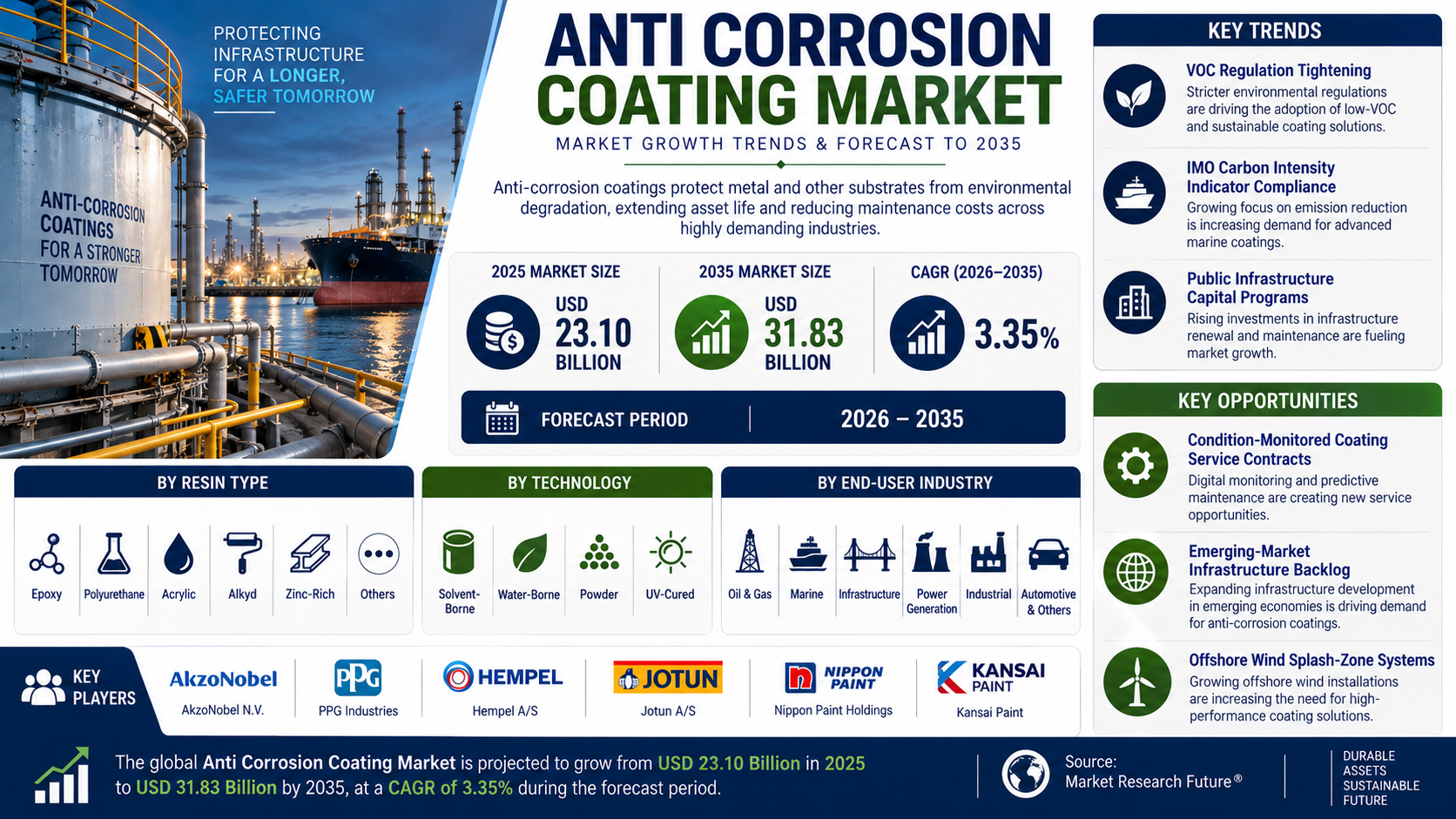

The anti corrosion coating market is advancing as infrastructure investment, environmental regulations and asset-protection needs reshape coating demand.
NY, UNITED STATES, September 17, 2026 /EINPresswire.com/ — The global anti corrosion coating market is projected to grow from USD 23.10 Billion in 2025 to USD 31.83 Billion by 2035, registering a CAGR of 3.35% during the 2026–2035 forecast period, according to Market Research Future®. Demand is being supported by the need to protect industrial assets, transportation infrastructure, marine structures, energy facilities and other metal-intensive applications from corrosion-related deterioration.
Anti-corrosion coatings provide protective barriers between metal surfaces and corrosive environments. Their applications span oil and gas facilities, marine assets, infrastructure, power generation, industrial equipment and automotive applications. The market encompasses resin technologies including epoxy, polyurethane, acrylic, alkyd and zinc-rich formulations, as well as solvent-borne, water-borne, powder and UV-cured coating technologies.
Get Sample Report PDF| https://www.marketresearchfuture.com/sample_request/3020
Asset Protection Remains Central to Coating Demand
Corrosion can increase maintenance requirements, shorten asset lifecycles and create operational challenges across industries that depend on steel and other metallic structures. As infrastructure and industrial assets age, protective coatings are increasingly being incorporated into maintenance, refurbishment and new-construction programs.
Infrastructure spending is particularly relevant because bridges, pipelines, storage facilities, industrial structures and transportation assets require durable protection against moisture, chemicals, salt and other corrosive conditions. Investment in the broader infrastructure construction market can therefore create downstream opportunities for coating manufacturers and application-service providers.
The need for long-term asset protection is also encouraging businesses to consider coating performance over the full operating lifecycle rather than focusing solely on initial application costs.
Environmental Regulations Are Reshaping Formulation Choices
Tightening VOC regulations are influencing coating formulation and application practices. Manufacturers are developing products that can meet performance requirements while reducing emissions associated with volatile organic compounds.
Water-based technologies are gaining attention as industries evaluate alternatives to conventional solvent-heavy formulations. This is contributing to development across the water-based coatings market, where formulation improvements are supporting applications that require corrosion protection while addressing environmental and workplace considerations.
Powder and UV-cured technologies also provide opportunities where application conditions and substrate requirements allow their use. These technologies can offer different curing characteristics and application efficiencies compared with conventional solvent-borne systems.
Marine and Offshore Applications Create Specialized Requirements
Marine environments expose coated surfaces to saltwater, humidity, immersion, abrasion and changing temperatures. These conditions create specialized requirements for protective coatings used on vessels, offshore structures, ports and related equipment.
The marine coatings market is therefore closely connected with anti-corrosion technology development. Coating systems used in marine applications must provide durable adhesion and resistance under demanding operating conditions, particularly in areas exposed to continuous or intermittent seawater contact.
The International Maritime Organization’s Carbon Intensity Indicator requirements are also influencing vessel efficiency and operational strategies. While carbon-intensity compliance primarily addresses emissions performance, changes in vessel operations and maintenance practices can influence decisions around asset preservation and coating systems.
Resin Technologies Define Performance Characteristics
The market is segmented by resin type into Epoxy, Polyurethane, Acrylic, Alkyd, Zinc-Rich and Others.
Epoxy coatings are widely used where strong adhesion, chemical resistance and durable protection are required. They can be applied across industrial equipment, infrastructure and energy-related assets.
Polyurethane systems can provide combinations of durability and weather resistance, making them relevant for applications exposed to outdoor conditions. Acrylic and alkyd formulations serve additional application requirements, while zinc-rich coatings are used where sacrificial protection is required.
The development of the epoxy resin market is relevant to the broader coatings ecosystem because epoxy-based materials are used across multiple protective and industrial applications.
Technology Shifts Expand the Coating Selection
By technology, the anti corrosion coating market is divided into Solvent-Borne, Water-Borne, Powder and UV-Cured systems.
Solvent-borne coatings remain established across applications where formulation performance and field application characteristics are important. At the same time, environmental regulations are encouraging greater attention toward water-borne and other lower-emission alternatives.
Powder coatings can provide efficient application and curing characteristics in controlled environments. The wider powder coatings market is therefore relevant to applications where substrates, production conditions and coating requirements support powder-based systems.
UV-cured technologies offer rapid curing potential and may provide opportunities in specialized industrial applications where controlled curing conditions are available.
Oil & Gas and Industrial Infrastructure Remain Important End Users
Oil and gas facilities operate in environments where pipelines, storage tanks, processing equipment and structural components can face exposure to moisture, chemicals and aggressive operating conditions. Protective coatings help support asset maintenance and can form part of broader inspection and corrosion-management programs.
Industrial facilities face similar challenges across machinery, structural steel, processing equipment and storage systems. The adoption of coating systems is often linked to maintenance schedules, operating environments and expected asset lifetimes.
Corrosion monitoring technologies can complement coating programs by helping asset operators identify areas requiring inspection or intervention. Developments in the corrosion monitoring market may therefore support more data-driven approaches to protective maintenance.
Infrastructure Investment Opens New Opportunities
Public infrastructure capital programs represent an important opportunity for anti-corrosion coating suppliers. Bridges, water infrastructure, transportation structures and public facilities require ongoing maintenance, rehabilitation and refurbishment.
New construction can create demand for protective coating systems during fabrication and installation, while existing infrastructure creates recurring opportunities through inspection and maintenance cycles.
The combination of aging assets and infrastructure investment can increase the need for coating solutions that balance durability, application requirements, environmental compliance and lifecycle economics.
Emerging Opportunity in Condition-Monitored Coating Services
Condition-monitored coating service contracts represent an emerging opportunity for suppliers and specialized maintenance companies. Instead of treating coating as a periodic standalone activity, asset owners can integrate inspection, coating condition assessment and maintenance planning into longer-term service agreements.
Digital inspection tools and corrosion monitoring systems can potentially help operators prioritize maintenance based on asset condition. This approach can support more targeted coating interventions and reduce reliance on fixed maintenance schedules alone.
Emerging Markets Offer Infrastructure-Driven Potential
Infrastructure backlogs in emerging markets can create additional demand for protective coating technologies. Industrialization, energy infrastructure expansion, transportation projects and urban development can increase the installed base of steel and other corrosion-sensitive assets.
For coating manufacturers, these markets can provide opportunities across new construction as well as maintenance and rehabilitation. Local application capabilities, climate conditions, regulatory requirements and project economics will influence adoption patterns.
Offshore Wind Creates a Specialized Growth Avenue
Offshore wind development is creating another application area for advanced corrosion protection. Turbine foundations and other offshore structures can experience demanding exposure conditions, including seawater, splash-zone wetting, humidity and mechanical stresses.
Splash-zone coating systems require specialized performance because this area can experience repeated transitions between wet and dry conditions. The expansion of offshore wind infrastructure could therefore create demand for coating systems designed specifically for these environments.
Competitive Landscape
The anti corrosion coating market includes global coating manufacturers and specialized suppliers competing across resin technologies, application technologies and end-user industries.
Key players include AkzoNobel N.V., PPG Industries, Hempel A/S, Jotun A/S, Nippon Paint Holdings and Kansai Paint.
Competition is influenced by coating performance, formulation development, regulatory compliance, application support, geographic reach and relationships with industrial and infrastructure customers. Manufacturers are also investing in product development as customers seek solutions that combine corrosion resistance with environmental and operational requirements.
Outlook Through 2035
The anti corrosion coating market is expected to continue developing alongside infrastructure investment, industrial maintenance and environmental regulation. Demand will remain connected to the need to extend asset service life and reduce the effects of corrosion across critical applications.
VOC regulation tightening will continue to influence formulation strategies, while marine and offshore applications will require coatings capable of performing under increasingly demanding environmental conditions.
Public infrastructure capital programs and emerging-market infrastructure development can create additional opportunities, while condition-monitored coating services may strengthen the connection between protective coatings and predictive maintenance.
The transition toward lower-emission technologies, combined with continued demand for durable protection across energy, marine, infrastructure, industrial and automotive applications, will remain important to the market’s development through 2035.
Read the full Anti Corrosion Coating Market Research Report:
https://www.marketresearchfuture.com/reports/anti-corrosion-coating-market-3020
Forecast Period: 2026–2035
2025 Market Size: USD 23.10 Billion
2035 Market Size: USD 31.83 Billion
CAGR: 3.35%
Related Insights
India Tile Adhesive Market https://www.marketresearchfuture.com/reports/india-tile-adhesive-market-4655
India Biomass Pellets Market https://www.marketresearchfuture.com/reports/india-biomass-pellets-market-44388
Biomass Market https://www.marketresearchfuture.com/reports/biomass-market-18830
Manganese Market https://www.marketresearchfuture.com/reports/manganese-market-7724
Global Chemical Industry https://www.marketresearchfuture.com/reports/global-chemical-industry-33564
Market Research Future
Market Research Future
+1 855-661-4441
email us here
Legal Disclaimer:
EIN Presswire provides this news content “as is” without warranty of any kind. We do not accept any responsibility or liability
for the accuracy, content, images, videos, licenses, completeness, legality, or reliability of the information contained in this
article. If you have any complaints or copyright issues related to this article, kindly contact the author above.

Media gallery