
Molecular Sieves Market to Grow from USD 4.70 Billion in 2026 to USD 7.23 Billion by 2035 at 4.9% CAGR
APAC leads the Molecular Sieves Market with a 46% share, underpinned by heavy industrial output in China, India, and
Press Release Disclaimer: This is a press release distributed through the XPR Media network. It has not been independently verified by our newsroom.
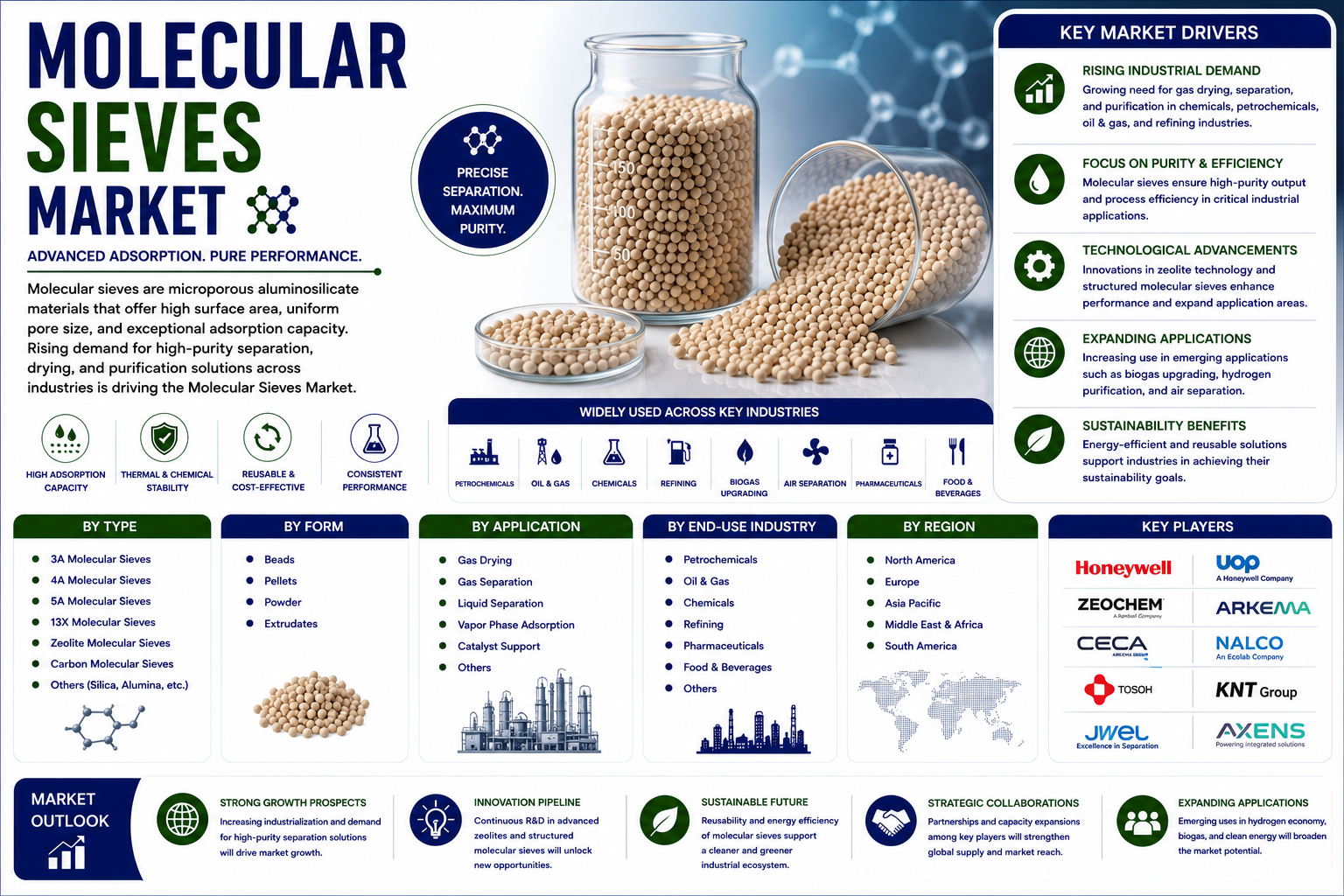

APAC leads the Molecular Sieves Market with a 46% share, underpinned by heavy industrial output in China, India, and ASEAN nations
WA, UNITED STATES, August 21, 2026 /EINPresswire.com/ — The global molecular sieves market is entering a period of steady, structurally supported expansion. Valued at an estimated $4.48 billion in 2025, the market is projected to grow from $4.70 billion in 2026 to approximately $7.23 billion by 2035, registering a compound annual growth rate of 4.9%. This growth is being propelled by tightening environmental regulations on volatile organic compound emissions, massive petroleum refining capacity expansions across Asia-Pacific and the Middle East, and the emergence of hydrogen purification and biogas upgrading as new demand verticals.
The Regulatory and Industrial Architecture
Two powerful forces are reshaping the molecular sieves landscape. On the environmental front, the U.S. Environmental Protection Agency finalized revised National Emission Standards for Hazardous Air Pollutants rules for petroleum refineries in 2024, mandating a 35% reduction in fugitive VOC emissions by 2028. Compliance pathways increasingly rely on pressure-swing adsorption and temperature-swing adsorption systems loaded with high-performance zeolite adsorbents. In Europe, the recast Industrial Emissions Directive proposes binding best-available-technology conclusions that explicitly reference zeolite-based adsorption as a preferred abatement method, creating a regulatory pull for advanced separation technology across the continent.
On the industrial front, global refining throughput is set to expand by an estimated 6.2 million barrels per day between 2025 and 2032, with over 60% of new capacity concentrated in Asia-Pacific and the Middle East. Every new fluid catalytic cracking or hydrocracking unit requires zeolite materials and industrial desiccants for feed-gas conditioning, catalyst bed regeneration, and product dehydration. China’s Zhejiang Petrochemical Phase-III project alone will demand an estimated 4,800 metric tons of molecular sieve inventory upon commissioning, illustrating the scale of demand each mega-refinery generates.
Market Size and Forecast Trajectory
Market Research Future’s estimates combine manufacturer revenue disclosures, trade-level import and export data, and top-down cross-validation against macroeconomic factors such as industrial output indices and refinery utilization rates. Historical figures from 2021 through 2024 are based on customs data and industry association disclosures. The market has grown from $3.7 billion in 2021 and is expected to reach $5.17 billion by 2028 before climbing steadily toward the $7.23 billion endpoint in 2035.
Request Free Sample Copy: https://www.marketresearchfuture.com/sample_request/8437
Segment Analysis by Product Type
Zeolite-based molecular sieves command the dominant share of the market, capturing approximately 52% of global revenue in 2025. This dominance reflects the material’s unmatched combination of thermal stability, regenerability, and tunable pore dimensions. No competing material matches zeolite’s performance across the core applications of natural-gas dehydration, ethanol purification, and refinery gas separation. Type 4A zeolite remains the standard for pipeline natural-gas dehydration because it selectively adsorbs water while excluding methane and heavier hydrocarbons.
Carbon-based molecular sieves represent the fastest-growing product type, projected to expand at a 6.1% CAGR through 2035. This acceleration is driven by surging biogas-upgrading installations in Europe and South America, where carbon molecular sieves separate methane from carbon dioxide at ambient temperatures without chemical solvents. Silica gel is growing at a 3.8% CAGR, serving cost-sensitive humidity-control applications. Clay-based sieves were valued at approximately $0.18 billion in 2025, serving low-cost industrial filtration needs. Porous glass captured roughly 3% of the market, serving niche laboratory and sensor applications.
Segment Analysis by Shape
Pelleted molecular sieves lead by shape, accounting for approximately 44% of market revenue in 2025. Their uniform geometry ensures predictable pressure drop and flow distribution in large-diameter adsorption columns found in refineries and gas plants, making them the default specification for fixed-bed gas dehydration.
Beaded forms are the fastest-growing shape segment, expanding at a 5.3% CAGR. Spherical geometry minimizes attrition and dust formation during thousands of pressurization-depressurization cycles, making beaded variants the preferred choice for rapid-cycle pressure-swing adsorption units. This segment attracts premium pricing in high-cycle air purification applications. Powdered sieves generated approximately $0.67 billion in 2025, primarily serving detergent formulations and polymer additive blending where zeolite builders replace phosphates.
Segment Analysis by Pore Classification
Microporous sieves, encompassing the workhorse Type 3A, 4A, 5A, and 13X designations, constitute approximately 62% of the market. Their sub-2-nanometer pore openings deliver the sharp size-exclusion selectivity required for moisture control in natural-gas dehydration and pharmaceutical solvent recovery.
Mesoporous variants are the fastest-growing pore category, advancing at a 5.6% CAGR. Their larger pore architecture accommodates bulky hydrocarbon molecules in catalytic cracking catalyst supports and specialty-chemical synthesis, opening applications where traditional microporous structures would exclude target molecules. Macroporous sieves were valued at approximately $0.22 billion in 2025, serving primarily as pre-filtration and guard-bed materials that protect downstream microporous beds from particulate contamination.
Buy Now: https://www.marketresearchfuture.com/checkout?currency=one_user-USD&report_id=8437
Segment Analysis by End-User Industry
Oil and gas operations remain the largest end-user industry, generating approximately $1.48 billion in 2025. This dominance reflects the sector’s continuous need for gas separation adsorbents, catalytic materials, and industrial desiccants across upstream dehydration, midstream pipeline specification, and downstream product purification. Every stage of the hydrocarbon value chain relies on molecular sieves to prevent hydrate formation, remove moisture to cryogenic specifications, and condition feed gas for catalytic processes.
Waste and water treatment is the fastest-growing end-user segment, projected to expand at a 5.8% CAGR. Governments worldwide are tightening discharge standards for pharmaceutical residues, per- and polyfluoroalkyl substances, and heavy metals, contaminants for which zeolite and carbon-based adsorbents have demonstrated strong removal efficiency. China’s 14th Five-Year Plan for Ecological and Environmental Protection prioritizes water-pollution control infrastructure, while municipalities across Europe and North America are adopting adsorption-based tertiary treatment to remove micropollutants that biological processes cannot address.
The pharmaceutical industry captured approximately 12% of market share in 2025. Regulatory guidelines from the FDA and European Medicines Agency regarding residual solvent limits in active pharmaceutical ingredients continue to drive demand for Type 3A zeolite materials in high-purity ethanol and isopropanol dehydration. India’s pharmaceutical sector achieved record exports of approximately $30.5 billion in fiscal year 2025, reinforcing sustained demand for high-purity separation adsorbents.
Automotive applications are growing at a 4.5% CAGR, driven by brake-system desiccation and refrigerant drying in electric vehicle thermal management systems. Cosmetics and detergents contributed approximately $0.31 billion, where zeolite builders continue to replace phosphates in environmentally formulated cleaning products.
Regional Landscape: Asia-Pacific Dominates, All Regions Expand
Asia-Pacific commands the largest share of the global molecular sieves market at approximately 46% of revenue in 2025, and it is also the fastest-growing region with a projected 5.4% CAGR. This dominance reflects the region’s concentration of refining, petrochemical, and manufacturing capacity. China alone captures roughly 54% of the regional share, with mega-refinery builds and environmental remediation programs driving massive zeolite consumption.
India’s city-gas distribution rollout is creating fresh demand, with the Petroleum and Natural Gas Regulatory Board authorizing 295 licenses that each require gas drying agents for pipeline-quality specifications. Japan contributed approximately $0.18 billion, focused on specialty-chemical manufacturing and electronics-grade solvent dehydration. South Korea holds roughly 8% of the regional share through petrochemical complex upgrades. The ASEAN bloc is expanding at a 5.5% CAGR through refinery and liquefied natural gas infrastructure buildout.
North America holds the second-largest global share at approximately 22%, generating roughly $0.99 billion in 2025. The United States dominates with approximately 74% of regional revenue, anchored by Permian Basin gas processing and EPA compliance-driven refinery retrofits. Natural-gas dehydration consumes the single largest volume of Type 4A and 13X molecular sieves in the region. Canada is growing at a 4.5% CAGR, supported by the LNG Canada facility in Kitimat, British Columbia, which requires substantial gas drying agents during commissioning. Mexico contributed approximately $0.06 billion through PEMEX refinery rehabilitation programs.
Report Summary: https://www.marketresearchfuture.com/reports/molecular-sieves-market-8437
Europe accounts for roughly 19% of global market revenue. Germany anchors the region with approximately 22% of European share, driven by the continent’s largest chemicals sector and its consistent demand for solvent-recovery and emission-control adsorbents. The United Kingdom is growing at a 4.3% CAGR through North Sea decommissioning and hydrogen blending trials. France contributed approximately $0.15 billion, supported by nuclear hydrogen programs and domestic Arkema supply. Italy captures roughly 11% of the regional share through refinery conversion to biorefineries. Spain is expanding at a 4.7% CAGR through renewable-gas injection mandates. The Nordic countries contributed approximately $0.07 billion through biogas-to-grid projects. Russia holds roughly 9% of regional share through domestic refinery modernization. The rest of Europe is growing at a 4.4% CAGR as Industrial Emissions Directive retrofit demand spreads.
South America was valued at approximately $0.23 billion in 2025 and is expanding at a 5.1% CAGR. Brazil dominates with roughly 58% of the regional share through the RenovaBio biomethane program and Petrobras refinery upgrades. Argentina is growing at a 5.3% CAGR through Vaca Muerta shale-gas development, which is attracting foreign direct investment in gas processing infrastructure.
The Middle East and Africa contributed approximately $0.28 billion in 2025. Saudi Arabia leads with roughly 34% of regional revenue through Saudi Aramco’s Jafurah unconventional gas program, which targets 2 billion standard cubic feet per day by 2030 and will require massive inventories of gas separation adsorbents for feed conditioning. The United Arab Emirates is growing at a 5.0% CAGR through ADNOC gas-processing expansion. South Africa contributed approximately $0.03 billion through Sasol coal-to-liquids operations. Egypt is expanding at a 4.8% CAGR through Mediterranean gas-field development.
Competitive Landscape
The molecular sieves market exhibits low concentration, with an estimated Herfindahl-Hirschman Index below 800. The top five manufacturers together account for an estimated 35 to 40% of global revenue, indicating a fragmented competitive structure where regional experts and vertically integrated chemical conglomerates coexist.
Honeywell, through its UOP subsidiary, leads with an estimated 8 to 11% revenue share. The company offers MOLSIV adsorbents combined with pressure-swing adsorption and temperature-swing adsorption system design, achieving vertical integration as a technology licensor. BASF SE captures roughly 7 to 10% as a scale-driven cost leader with global logistics capabilities, producing Type 4A and 13X zeolite beads alongside a broad catalytic materials portfolio.
Tosoh Corporation holds approximately 5 to 8% with premium positioning in Asia-Pacific markets, offering Zeolum high-silica zeolites and specialty grades for demanding applications. Arkema, through its CECA subsidiary, captures roughly 5 to 7% with strong European market presence, marketing Siliporite molecular sieves and gas drying agents. W.R. Grace accounts for approximately 4 to 6% through its SYLOBEAD adsorbents and integrated refining-catalyst portfolio.
Zeochem AG holds roughly 3 to 5% as a medical and industrial gas specialist with its Z10-Series adsorbents and oxygen concentrator sieves. Clariant AG captures approximately 3 to 5% through OxyClean pressure-swing adsorption sorbents, focusing on environmental and specialty applications. Hengye Inc. accounts for roughly 2 to 4% as a cost-competitive Chinese manufacturer of Type 3A, 4A, 5A, and 13X pellets and beads. KNT Group holds approximately 2 to 4% with activated molecular sieves and industrial desiccants, leveraging distribution networks across the Commonwealth of Independent States and Eastern Europe. Luoyang Jianlong rounds out the competitive set with roughly 2 to 3% through high-volume commodity zeolite pellets, combining domestic Chinese scale with export ambitions.
Regional Report
france molecular sieves market https://www.marketresearchfuture.com/reports/france-molecular-sieves-market-48921
china molecular sieves market https://www.marketresearchfuture.com/reports/china-molecular-sieves-market-49062
us molecular sieves market https://www.marketresearchfuture.com/reports/us-molecular-sieves-market-20342
europe molecular sieves market https://www.marketresearchfuture.com/reports/europe-molecular-sieves-market-49004
russia molecular sieves market https://www.marketresearchfuture.com/reports/russia-molecular-sieves-market-48927
apac molecular sieves market https://www.marketresearchfuture.com/reports/apac-molecular-sieves-market-48967
germany molecular sieves market https://www.marketresearchfuture.com/reports/germany-molecular-sieves-market-48923
japan molecular sieves market https://www.marketresearchfuture.com/reports/japan-molecular-sieves-market-48926
south korea molecular sieves market https://www.marketresearchfuture.com/reports/south-korea-molecular-sieves-market-48949
Market Research Future
Market Research Future
+ +1 855-661-4441
email us here
Legal Disclaimer:
EIN Presswire provides this news content “as is” without warranty of any kind. We do not accept any responsibility or liability
for the accuracy, content, images, videos, licenses, completeness, legality, or reliability of the information contained in this
article. If you have any complaints or copyright issues related to this article, kindly contact the author above.

Media gallery


