Axonis Launches Mission Node to Bring AI-Powered Decision Intelligence to the Tactical Edge
New AI-enabled intelligence solution enables more autonomous, interconnected, and adaptable defense operations, even
Press Release Disclaimer: This is a press release distributed through the XPR Media network. It has not been independently verified by our newsroom.


New AI-enabled intelligence solution enables more autonomous, interconnected, and adaptable defense operations, even when connectivity is degraded or denied
ARLINGTON, MA / ACCESS Newswire / September 9, 2026 / Axonis, the AI solutions developer that governs high-stakes decisions across distributed data, today introduced Axonis Mission Node, a self-contained, AI-enabled mission intelligence environment designed for defense operations at the edge. Axonis Mission Node enables organizations to connect mission data and AI, generate intelligence, and make governed decisions locally, even when communications with centralized infrastructure are disconnected.
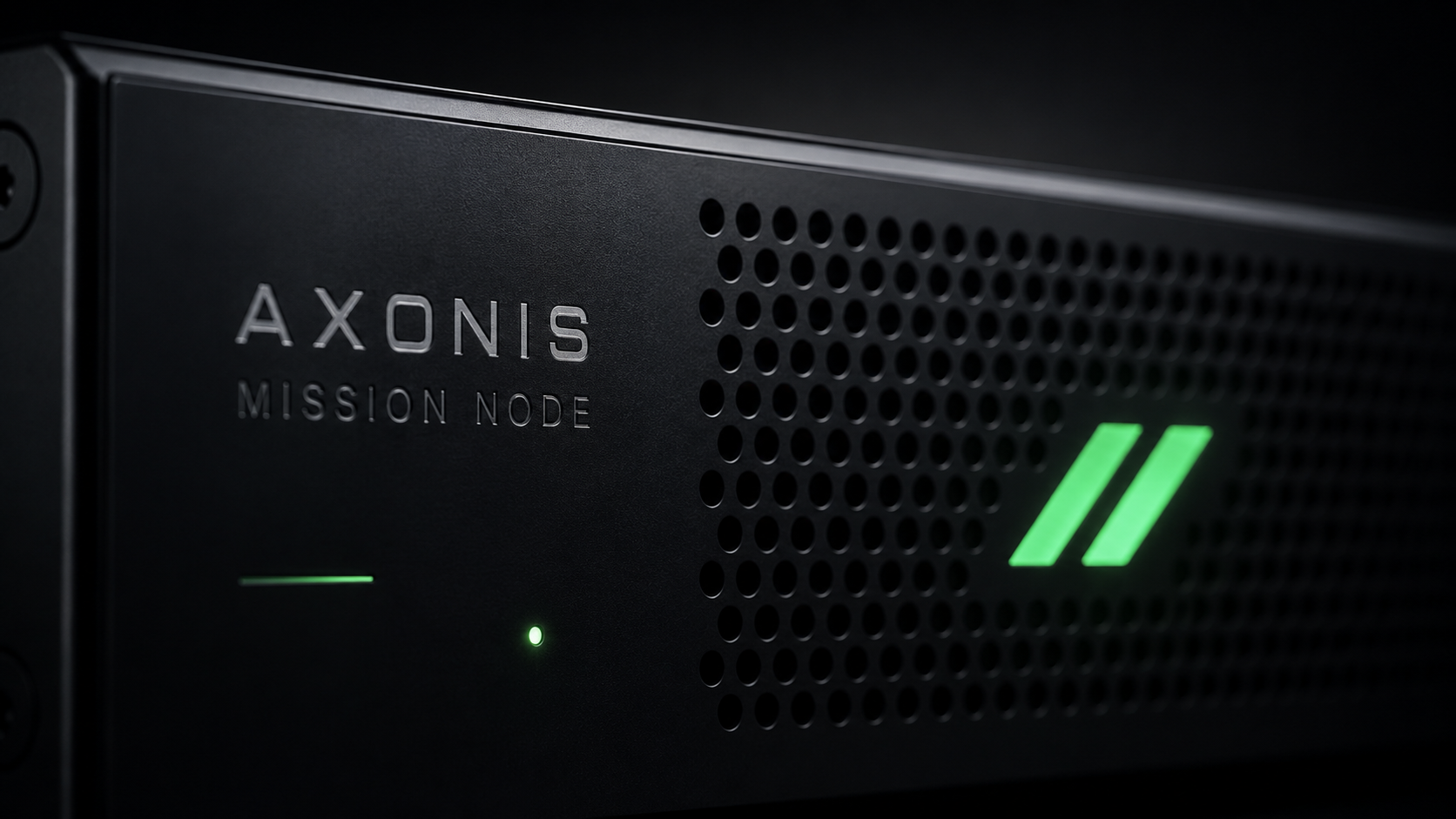
“AI, autonomous systems, and distributed operations are reshaping the speed and complexity of military operations. But traditional intelligence architectures still depend on moving data to centralized infrastructure or the cloud, creating a critical dependency in contested environments where communications may be degraded or denied. We built Axonis Mission Node to bring intelligence directly to the mission, so commanders can identify patterns, make decisions, and act without depending on a connection back to centralized infrastructure. It keeps humans in control while giving them the speed, intelligence, and adaptability they need to operate in a rapidly changing environment,” said Todd Barr, CEO of Axonis.
Axonis Mission Node Increases Cognitive Tempo
Axonis Mission Node brings data, AI, and decision-making together at the point of mission execution, enabling commanders to configure the mission, connect their data and AI, expose patterns through prediction, matching, fusion and scoring, and then decide and act.
This approach changes how intelligence can be applied in the field, enabling greater autonomy while maintaining human control, supporting interdependence across distributed forces, and creating a foundation for continuous adaptation.
Autonomy: As machines provide greater speed and scale, humans provide mission context and intent. At the core of Axonis Mission Node is the Mission Pack, which allows commanders to configure the data, signals, thresholds, decision flows, and effects that define a mission. This puts human intent into the operational framework from the outset, providing the foundation for greater trusted autonomy while keeping humans in control.
Interdependence: Axonis Mission Node is built on a decentralized architecture. Each node can operate independently when disconnected and connect to enterprise systems when communications are available. Multiple Mission Nodes can federate intelligence across authorized joint and coalition environments, enabling organizations to share intelligence without sharing or centralizing their underlying sovereign data.
Adaptability: Every decision is saved as a cryptographically sealed artifact, creating what Axonis calls decisions-as-data. These records preserve the evidence and context behind decisions and create a training corpus that can be used to improve models and future decision-making, enabling forces to continuously learn and adapt.
“The Praxis AI Doctrine argues that human intent must govern machine execution, or a decision isn’t defensible. Axonis Mission Node is where that principle becomes running infrastructure. AI moves to the data. Every decision is captured as evidence, not asserted after the fact. And now a coalition can share intelligence without needing to centralize the sovereign data behind it. It’s the first platform I’ve seen built to fight in the Cognitive Age, not just describe it,” said Yi Se Gwon, COL, U.S. Army (Ret.), author of The Praxis AI Doctrine – Warfare in the Cognitive Age.
Bringing AI to Mission Data
Axonis Mission Node applies its proven decentralized decision intelligence architecture to defense environments where operational resilience, data control, and decision speed are critical. It connects distributed data with an organization’s AI models, including local and cloud-based models, and applies prediction, matching, fusion, and scoring to expose patterns and generate intelligence. Authorized personnel can then make and attest to decisions, preserving accountability while taking advantage of machine speed and scale.
A single Mission Node can operate independently on a command’s data. Multiple nodes can federate intelligence across authorized joint and coalition environments without requiring the underlying sovereign data to be shared or centralized. This enables intelligence to move across the operational environment while data remains under the control of the organization that owns it.
See Axonis Mission Node at AUSA 2026
Axonis will showcase Mission Node at the AUSA 2026 Annual Meeting & Exposition in Washington, D.C. Attendees can book a meeting with Axonis leadership to learn more about Axonis Mission Node and the company’s approach to AI-enabled defense intelligence: https://bookings.cloud.microsoft/book/AxonisAUSADiary@axonis.ai/?ismsaljsauthenabled.
Learn more about Axonis Mission Node at: axonis.ai/mission-node.
About Axonis
Axonis brings AI to the data, wherever that data lives, and turns it into trusted, actionable decisions. Originally developed inside a U.S. government solutions provider serving the Department of Defense and Intelligence Community, Axonis enables secure, real-time AI on production, operational, sovereign, and edge data, without moving it.
At the core of the platform is Decision Intelligence, providing the control layer that ensures every AI-driven outcome is grounded in the right data, governed by policy, and fully traceable. Axonis accelerates time-to-AI value while delivering zero-trust, data-level security, and enabling cross-organization collaboration without sharing data.
For more information visit www.axonis.ai.
Press Contact
Kristin Canders
207-974-7744
kristin@grithaus.agency
SOURCE: Axonis
View the original press release on ACCESS Newswire
Media gallery